Modelo 720 and digital nomads: who has to file it and what happens if you don’t
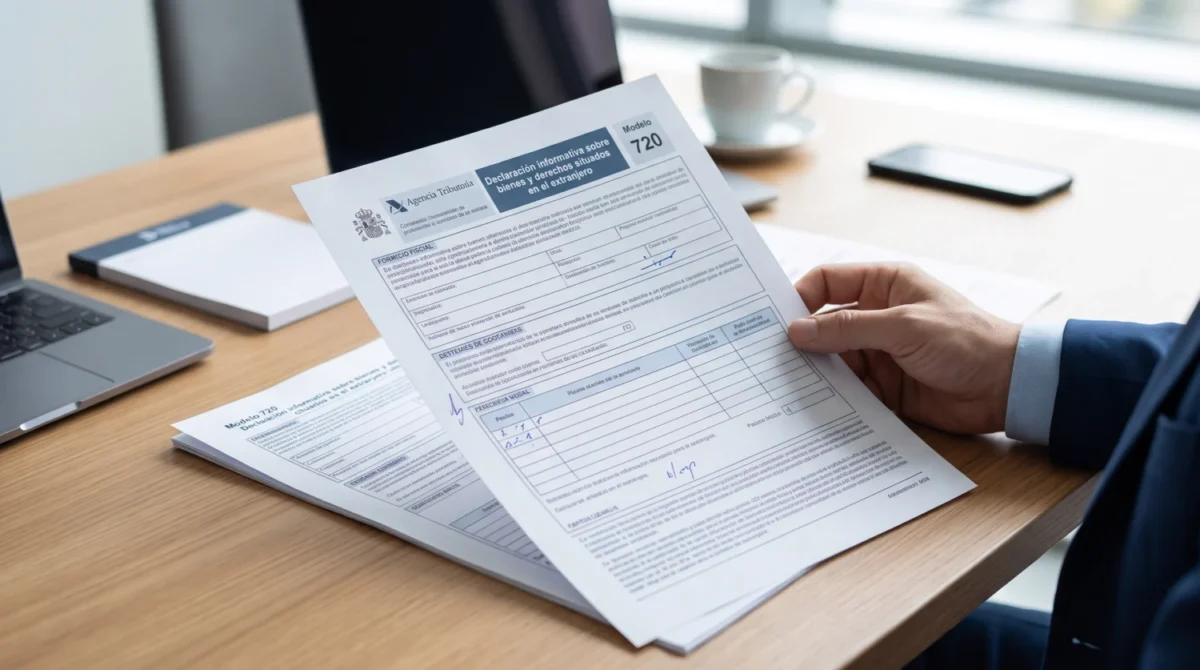
Modelo 720 is the annual information return through which tax residents in Spain report to the Spanish Tax Agency (AEAT) the assets and rights they hold outside the country. For a foreign worker in Spain, digital nomads included, the obligation arises once they become tax resident and keep accounts, securities or property abroad above the legal thresholds. This guide covers the specific case of Modelo 720 for foreign workers in Spain: who must file it, who need not, and what happens if you fail to comply.
Everything hinges on a prior question: are you already tax resident in Spain? We explain how that status is acquired in our page on tax residence for digital nomads. Here we assume you already are, or are about to be.
Key points
- Residents only: Modelo 720 is filed by tax residents in Spain, not by non-residents.
- Threshold per block: 50,000 euros in accounts, in securities or in property abroad, and each block is assessed separately.
- Deadline: from 1 January to 31 March of the year following the one being reported.
- Year of arrival: newcomers are only obliged for the tax year in which they are already resident, not for earlier years.
- After the CJEU ruling: since the 2022 judgment the obligation remains, but the disproportionate fixed fines and the absence of a limitation period are gone.
What Modelo 720 is and why it affects foreign workers
Modelo 720 is an information return, not a tax: it does not trigger any payment in itself, but failing to file it can lead to penalties. It is governed by the eighteenth additional provision of the General Tax Act (Ley General Tributaria) and by Order HAP/72/2013, published in the BOE, which approved the form and set how and when it must be filed.
A digital nomad or foreign worker who settles in Spain usually keeps bank accounts in their home country, investments with international brokers or a home in their name. As soon as they become tax resident, those assets fall within the scope of Modelo 720, even if all their income comes from foreign clients or employers.
Modelo 720 for foreign workers in Spain: who must file
Modelo 720 must be filed by any individual who is tax resident in Spain and is the holder, beneficiary, authorised person or has power of disposal over assets abroad above the thresholds. Tax residence is generally acquired by spending more than 183 days in Spain in a calendar year or by having your centre of economic interests here, as we explain in our article on the 183-day rule and tax residence.
Modelo 720 is divided into three independent blocks, according to the Spanish Tax Agency’s FAQs:
- Accounts with financial institutions located abroad.
- Securities, rights, insurance and investment instruments deposited or managed outside Spain.
- Real estate and rights over real estate located abroad.
Cryptocurrencies held on foreign platforms are not reported on Modelo 720 but on Modelo 721, which follows the same threshold and deadline logic.
Thresholds and how assets are valued
The 50,000-euro threshold applies to each block separately, so you may be obliged to report your accounts but not your property. Valuation depends on the type of asset, as set out by the AEAT:
| Block | How it is valued | When you must file again |
|---|---|---|
| Bank accounts | Balance at 31 December and average balance for the last quarter (whichever is higher) | If the block as a whole increases by more than 20,000 euros |
| Securities and rights | Value at 31 December | If the block as a whole increases by more than 20,000 euros |
| Real estate | Acquisition value | If the block as a whole increases by more than 20,000 euros or a declared property is sold |
Where ownership is shared, each co-owner reports their percentage and calculates their own threshold, so some co-owners may be obliged and others not.
What happens in the year you move to Spain
Someone who was not resident one year and becomes resident the next is only obliged for the year in which they are resident, as the Spanish Tax Agency itself makes clear. You do not have to report retroactively for the years you lived abroad.
In practice, if you become resident in a given year, your first return is filed between 1 January and 31 March of the following year, using balances and values at 31 December. It pays to plan ahead: gathering statements, securities certificates and title deeds before the year ends avoids last-minute rushes and valuation errors.
What if you opt for the inbound expatriate regime (Beckham Law)?
The special inbound expatriate regime in Article 93 of the Personal Income Tax Act changes the picture, because those who apply it are taxed, in essence, as non-residents on income obtained outside Spain. According to the prevailing view, while you are under that regime you do not have to file Modelo 720, although you should check this case by case.
Act 35/2006 on Personal Income Tax, in the BOE, sets out the requirements, including not having been resident in the previous five tax periods and moving to Spain because of an employment contract, an appointment or international remote work. If the regime is lost or expires, the Modelo 720 obligation may reappear. We cover this in our guide to the Beckham Law for digital nomads.
What happens if you do not file Modelo 720
Failing to file Modelo 720, or filing it with incomplete or false data, is still a tax offence, but under the general penalty regime. According to the Spanish Tax Agency, following the CJEU judgment of 27 January 2022 (Case C-788/19) and Act 5/2022, Articles 198 and 199 of the General Tax Act apply, with separate penalties for each of the three blocks.
This is what changed with the judgment:
- The fixed fines of 5,000 euros per item of data (minimum 10,000 euros) under the previous regime have gone.
- The unjustified capital gain with no limitation period, and its 150% penalty, have gone.
- The reporting obligation remains: not filing is still an offence.
On top of this, the automatic exchange of financial information between countries (the OECD Common Reporting Standard) makes it increasingly unlikely that a foreign account will go unnoticed. If you have not filed for years, regularising voluntarily before receiving a request usually reduces the cost considerably, and penalties imposed under the old regime may be open to review depending on the case.
Common mistakes made by foreign workers
The most common mistake is assuming Modelo 720 does not apply because your income comes from abroad. The obligation depends on residence and on the assets, not on where the income comes from. Other frequent errors:
- Confusing the overall threshold with the threshold per block.
- Forgetting accounts with neobanks or investment platforms based outside Spain.
- Valuing assets incorrectly in a currency other than the euro or using the wrong date.
- Not updating the return after an inheritance, a purchase or closing a declared account.
- Not filing again when a block already declared rises by more than 20,000 euros.
How to approach your first Modelo 720 without surprises
To file Modelo 720 correctly, follow an order: confirm your tax residence, list all your assets abroad, value them at 31 December, check the thresholds per block and file within the deadline.
If you are unsure whether it affects you or need to regularise past years, our team handles these cases remotely and in several languages through our page on Form 720 for digital nomads and foreign residents, or you can contact the firm.
Frequently asked questions about Modelo 720
Does a foreign worker who has just arrived have to file Modelo 720?
A foreign worker who has just arrived files Modelo 720 only if they are already tax resident in Spain in that year and their assets abroad exceed 50,000 euros per block at 31 December. They do not report the years before becoming resident.
Is a digital nomad obliged to file Modelo 720?
A digital nomad must file Modelo 720 if they are tax resident in Spain and exceed the threshold in accounts, securities or property abroad. If they are not tax resident, there is no obligation, even if they live in the country temporarily.
What is the deadline for Modelo 720?
The Modelo 720 deadline runs from 1 January to 31 March of the year following the one reported. Assets are valued at 31 December and, for accounts, the average balance for the last quarter is also taken into account.
Do you have to file Modelo 720 every year?
Modelo 720 is not filed every year: after the first return, it is only filed again if a block increases by more than 20,000 euros compared with the last return, or if a declared asset is cancelled or sold.
Are cryptocurrencies reported on Modelo 720?
Cryptocurrencies held abroad are not reported on Modelo 720 but on Modelo 721. Both forms share the 50,000-euro threshold and the filing deadline, but they are separate reporting obligations.
What happens if I do not file Modelo 720?
If you do not file Modelo 720 you commit a tax offence punishable under the general regime of Articles 198 and 199 of the General Tax Act. Since 2022, the fixed fines of 5,000 euros per item of data and the absence of a limitation period no longer apply.
Does Modelo 720 apply if I am under the Beckham Law?
The inbound expatriate regime in Article 93 of the Personal Income Tax Act treats the taxpayer like a non-resident for foreign income, so, according to the prevailing view, Modelo 720 is not filed while the regime applies. It is worth confirming this in each case.
Clear accounts abroad from day one
Modelo 720 for foreign workers in Spain is not a trap for newcomers, but a transparency obligation that is handled with order and a calendar. Knowing whether you are resident, how much you hold abroad and in which block is enough to comply with peace of mind and without unnecessary risks.
At Riera Consulting we have spent years helping foreign professionals who settle in Spain, and reviewing your situation before the year ends usually saves you unpleasant surprises in March. If you want to know whether Modelo 720 affects you or need to regularise previous years, speak to our team of tax lawyers and we will sort it out remotely, calmly and at your own pace.
Keep reading

The Beckham Law for digital nomads in Spain: when it pays off in 2026 and when it does not
Requirements, rates and limits of the Beckham Law for digital nomads in Spain: when it beats ordinary income…

How to count the 183 days: examples for digital nomads
When tax residence in Spain is triggered for a digital nomad: the 183-day rule, the other criteria in…

Qué es un nómada digital en España y quiénes pueden serlo
El avance de la digitalización y el auge del teletrabajo han dado lugar a la consolidación de un…
En 2023, cualquier persona que realice una actividad económica podrá acceder al régimen de impatriado
Desde 1 de enero de 2023, podrán acceder al régimen de impatriados no solo los trabajadores por cuenta…